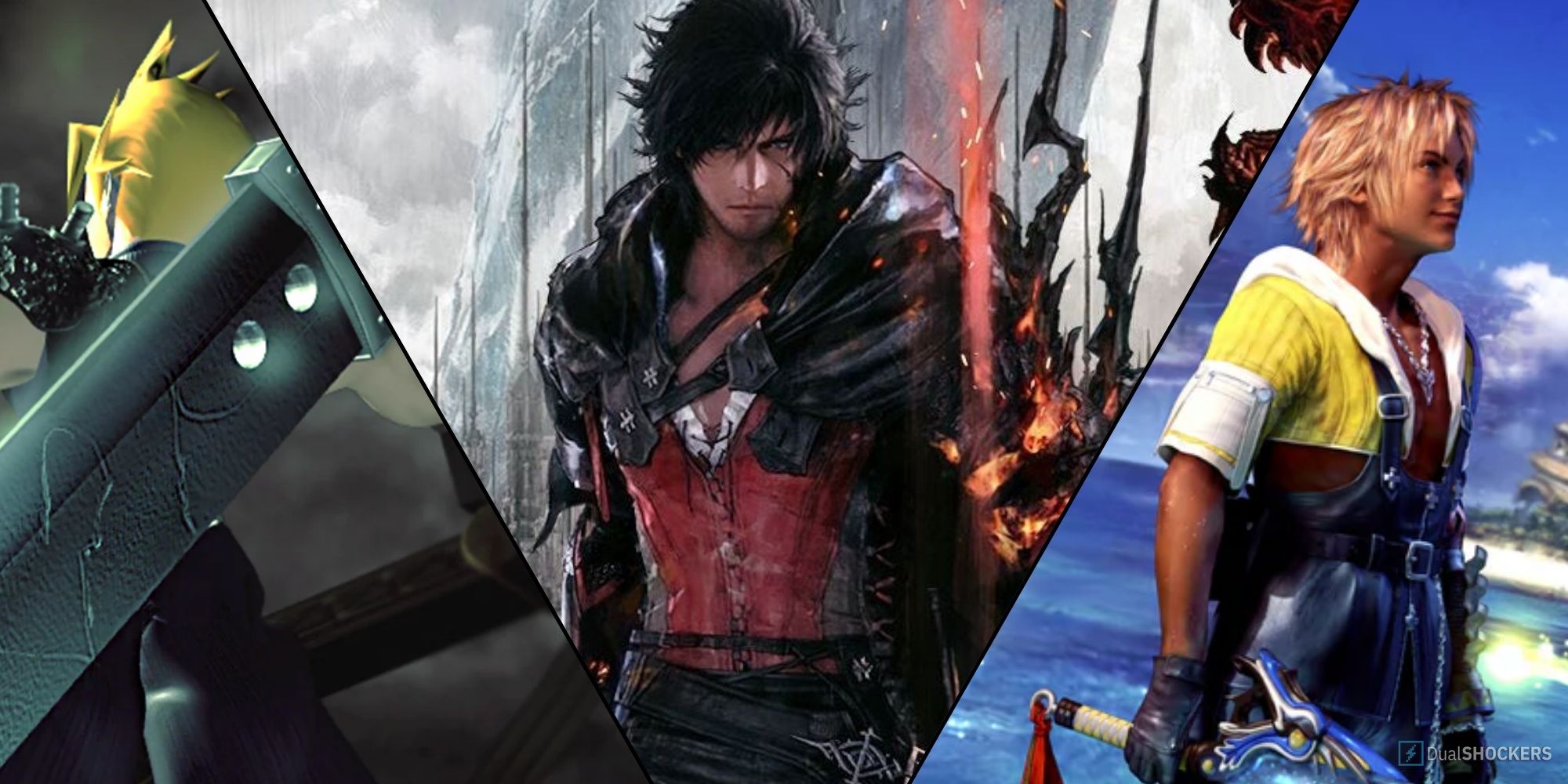
Firstly, I know there isn’t an optimal order to play all the Final Fantasy games and that every mainline is an entirely standalone experience. I’m not that stupid. However, humor me for a bit.
Suppose you are at gunpoint or someone is paying you to write a guide for a friend who knows nothing about the series and doesn’t particularly like JRPGs but is keen to try the Final Fantasy games.
Related
10 Best Square Enix Franchises, Ranked
Square Enix is one of the most prolific Japanese developers, but not all its franchises get the love they deserve.
Your goal is to help them discover and fall in love with the franchise gradually rather than scaring them away right from the start by suggesting Final Fantasy XIII.
That changes the perspective a bit, doesn’t it? And that’s precisely what I’ll try to do here. It doesn’t mean you have to agree with me, but why not try to make a suggestive list of Final Fantasy games to bring new fans to our beloved franchise? We all know Square loves that.
I won’t include MMORPGs because they’re entirely separate experiences, but I will add the remake of Final Fantasy VII alongside the classic.
1
Final Fantasy XVI
Your Entry Ticket

To ease new players in, I’ll start by suggesting the latest mainline, Final Fantasy XVI. Even though I disagree with Yoshi-P that new players don’t want turn-based RPGs, I do recognize that, statistically, action games are more popular than turn-based ones.
And it’s exactly in its action sequences that Final Fantasy XVI shines. The game lacks customization options and party members, allowing JRPG newcomers to play in a more streamlined way without spending hours on progression.
Besides that, FFXVI boasts a phenomenal story and breathtaking set pieces, especially in the Eikon battles, which serve as a great introduction to the mythology of the entire franchise. From Final Fantasy XVI and on, we’ll start diving into titles with more RPG elements.
2
Final Fantasy XV
A Final Fantasy For Fans And First-Timers

After booting up Final Fantasy XV, a message appears on the screen saying, “A Final Fantasy For Fans And First-Timers,” and the thing is, Square has been trying to do that with the franchise for a long time.
I believe that’s why none of the games are direct sequels, because, in the developers’ eyes, every entry is a starting point.
Final Fantasy XV marked the first time the franchise’s focus shifted to action, but unlike FFXVI, it still offers a good deal of customization, progression, and equipment. The latest versions of the game even let you control the party members, expanding the gameplay scope.
To be honest, Final Fantasy XV is one of my least favorite entries in the franchise. Yet, I recognize that it has a dedicated fanbase and one of the best party interactions. The good thing is that if you play this one, you’ll get used to some of the cheesy story beats of the series, as well as the magical chemistry the party characters always have with each other.
The game’s huge caveat? You’ll probably have to watch an anime and a movie, buy its recipe book, play all the DLCs, and read a novel to understand Final Fantasy XIV‘s whole universe, and you’ll still miss a few plot points here and there.
3
Final Fantasy VII Remake
Best of Both Worlds

For me, the combat in Final Fantasy VII Remake is one of the best action RPG systems nowadays. You can’t just mindlessly button mash. If you want to be efficient, you have to equip the right Materia, pay attention to enemy weaknesses, and master all your party members on the field.
Final Fantasy VII Remake brings the ATB system adapted for action. That’s why it’s an excellent introduction for players who don’t want to dive straight into a turn-based format but will still experience moments of pause, battle analysis, and the application of the best strategies.
Naturally, being a remake, it also incorporates various modern sensibilities that can appeal to newcomers. It’s never too late to discover one of the most famous casts in the JRPG world. Plus, if you like it, you can jump straight to Rebirth, which is one of the best games I’ve ever played in my life.
4
Final Fantasy X
Turn-Based Battle Starts

I asked a couple of friends about this list’s topics, and many of them suggested Final Fantasy X as an introduction. While I agree to some extent because it’s my favorite offline Final Fantasy, I know its full turn-based battle system, and the notorious random encounters might scare the uninitiated.
Still, after experiencing three different Final Fantasy games, all leaning more towards action, it’s time to join the big leagues and discover why old fans keep shouting that FF lost its essence when it abandoned command-based battles.

Related
10 Best JRPGs With ATB Combat Systems
Some people argue that ATB isn’t a true turn-based system. Still, it remains one of my favorite approaches to JRPG combat.
Final Fantasy X has a combat system called CTB, which stands for Conditional Turn-Based Battle. We can see the turn order of each fighter on the left side, but instead of everyone acting once per round, it’s possible to manipulate the order with skills and magic or if a party member is speedy.
The advantage of FFX’s combat over others is that it’s clear to see how each move really affects the gameplay, which motivates you to have a more tactical approach and even read the effects of every skill.
And if, by chance, you really don’t like turn-based combat but are loving every Final Fantasy plot, know that FFX has one of the most heartwarming and well-told stories in JRPGs, and that alone makes it worth investing your time.
5
Final Fantasy XII
Real-Time Turn-Based Gameplay

I considered suggesting Final Fantasy XII before Final Fantasy X, but perhaps it wouldn’t be ideal. Here, in the twelfth title, we still have the ATB system, and you can play it perfectly as if it were a turn-based game. But it wants you to opt for a more real-time mode.
While roaming the fields, we encounter enemies and immediately engage in combat. We can enter a command menu, select an action, and our characters will execute them. Easy-peasy, turn combat, yay!
However, FFXII features the Gambit system, which lets you program actions under certain conditions, and depending on how much time you dedicate to it, the gameplay enters auto-mode. That’s why I preferred to suggest a more traditional turn-based like Final Fantasy X before XII.
I imagine you’ll play the Zodiac Age version that introduces a modern staple of the Job System in the franchise. It’s still not as modular as Final Fantasy V, for example, but you can still make countless builds and personalized customizations to your liking.
And if you enjoyed the political schemes seen in Final Fantasy XVI, know that you’ll find more of them here. Bland protagonist Vaan aside, all the characters here are believable and human, allowing us to relate intimately with each one.
6
Final Fantasy VII
The Franchise’s Breakthrough

So far, most entries have been visually pleasant. However, from now on, we’re stepping into those that require a sort of acquired taste, like Final Fantasy VII and its blocky characters. Mind you, back in the day, those graphics were considered majestic, but they’re the characteristic that aged the worst in Final Fantasy VII.
To sum it up, this was the game that put the Final Fantasy series in the global spotlight. It presents an ambitious and, at times, complex story, a simple yet strategic battle system, and the famous CGs that brought a whole new level of production value to games.
If you manage to get past Final Fantasy VII’s graphical barrier, you’ll have one of the best gaming experiences of your life.
The combat here uses the ATB system, similar to what we see in Final Fantasy XII, but this time in its purest form. Each character has their own weapon and Limit Break, but you can tweak their builds with countless Materias.
If you like Final Fantasy VII, then consider the door wide open to dive into any other entry. I recommend playing the remastered version since it’s the most accessible one with a few quality-of-life upgrades.
7
Final Fantasy IX
Back To Fantasy

Let’s continue in the golden age of PS1 JRPGs with Final Fantasy IX, which was intended to be a return to the series’ high-fantasy style, featuring a more optimistic protagonist and a more colorful, vibrant setting.
FFIX also uses the same ATB system as Final Fantasy VII, but this time, each character is truly unique. It’s as if each party member belongs to a class with a set of skills, strengths, and efficiency. It’s something I deeply cherish, because I enjoy swapping my party at all times.
The narrative in Final Fantasy IX has a lighter tone, but that doesn’t mean its story is free of tragedies.
With each story beat, it dives deeper and deeper into problems and conflicts involving the world of Gaia, and even though this JRPG has one of the weakest final bosses in the franchise, Zidane and the gang’s journey is well worth it.
8
Final Fantasy VI
Magnum Ops

Now, I could tell you to wrap up the PS1 Final Fantasy trifecta, but that didn’t feel right. Hence, why I’m suggesting one of the best JRPGs on the SNES system and, for many, considered the best Final Fantasy overall.
Final Fantasy VI took several elements introduced in the fourth game and amplified them to a tenth power, delivering marvelous storytelling, highly relatable characters, a turn-based yet dynamic battle system, and one of the best villains in the genre.

Related
8 Things Clair Obscur: Expedition 33 Does Better Than Final Fantasy
Its level of polish, writing, and overall gameplay has set a standard that has sent shockwaves throughout the industry
The only possible caveat – not for me, but for you, newly arrived at the series – is its pixel art. There are various versions of Final Fantasy VI out there, but I recommend playing the Pixel Remaster. Ultimately, no matter which version you pick, stay away from that dreadful 3D Steam one, and you’ll be fine.
I’m a sucker for pixel art, but I know it can be a visual whiplash for those not used to it. However, if you don’t mind the adorable coziness of this artistic style or can at least tolerate it, prepare to dive into one of the most engaging narratives the video game medium has ever offered.
9
Final Fantasy IV
Defining Storytelling

At this point, you’ve already played all the top-tier Final Fantasy entries, and you’re familiar with countless systems. Now it’s time to fill your badge as a hardcore fan by checking out both the older entries and those less beloved.
While Final Fantasy IV doesn’t top other entries already mentioned, it’s a great game to understand when the series shifted to focus on fixed characters with predetermined stories and dramatic storytelling that would shape the entire franchise.
Getting to know Cecil, witnessing his redemption arc, the plot twists, and the numerous charismatic party members allows you to grasp what entails a Final Fantasy. It was in FFIV that the ATB system was first introduced, changing the whole landscape of turn-based games within then-SquareSoft.
Since we have a mostly fixed party, progression is based solely on each character’s level, their respective Job, and equipment. That means your choices in battle determine your success more than a specific build. And let’s face it, if you made it through Final Fantasy VI, the fourth game will be a walk in the park.
10
Final Fantasy V
Job Promotion

If by any chance you missed customization in Final Fantasy IV, now’s the time to crank it to the max with Final Fantasy V. The Job system wasn’t introduced here, but it was polished to the limit, to the point where it’s considered one of the best versions of this feature.
As we progress through the game, we unlock new Jobs and learn fresh abilities. When we switch to an untried Job, we can set a previously mastered one as a secondary command, massively expanding a character’s skillset.
I was never that good at this customization, but I know there are tons of game-breaking combinations.
The Job system and customization are the high points of Final Fantasy V. The game’s story, while well-rounded, doesn’t hit as hard as its predecessor’s. Still, you’ll get familiar with the cast and feel something in a few story beats, as long as you don’t mind the shenanigans of the main villain.