materials are typically used in microwave circuit board construction
Printed circuit board (PCB) materials provide the electrical isolation necessary for transmission lines and components to operate. PCB materials are available in rigid and flexible forms, with a broad spectrum of qualities that serve numerous different circuit design purposes. Understanding how these parameters relate to a board’s performance can help engineers select the best material for their specific application and fabrication process.
For the most part, microwave circuit board material selection is a matter of weighing performance against cost and manufacturability. FR-4 is the most popular choice, a glass fiber reinforced epoxy laminate known for its excellent insulation, mechanical strength, and temperature stability. It can be made in both rigid and flexible formats, with or without copper traces. Other rigid PCB materials include CEM-3 and PTFE, both of which offer superior electrical properties.
Microwave and RF PCBs operate at higher frequencies, with more complex and precise impedance tolerances. This means that the PCB must be able to dissipate heat more effectively and have less thermal resistance than lower-frequency boards. The thermal conductivity of the dielectric and copper material is an important factor in this regard. A high thermal conductivity allows the copper conductors to disperse heat faster, minimizing overheating and maintaining a stable operating temperature.
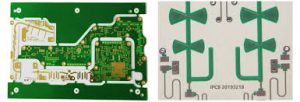
What materials are typically used in microwave circuit board construction?
The electrical conductivity of the dielectric material also plays a role. Typically, higher-frequency PCBs have wider conductors than lower-frequency ones, which requires a material with a low characteristic impedance to avoid signal loss. The Dk value of a dielectric material is an important metric in this context, with values higher or lower than a given frequency resulting in higher or lower conductor dimensions.
Another important attribute of a PCB material is its thermal expansion coefficient, which refers to how much the material expands and contracts with changes in temperature. A high coefficient is important to ensure that a PCB will be able to accommodate the expansion and contraction of components during manufacturing processes, preventing them from damaging each other or breaking apart.
Finally, a PCB material’s surface texture and etching are important considerations for high-frequency applications. For example, the roughness of a copper plating can significantly affect conductor loss, and this is especially true at higher frequencies. In general, smoother copper surfaces tend to have lower losses than rougher ones, but this is a function of both the PCB material and the copper surface treatment.
For this reason, plated copper on PCBs used in high-frequency applications are usually treated to reduce the roughness. This is done with a chemical wash, which is an inexpensive and effective way to minimize conductor loss and improve performance. It is also a good idea to use untented vias for high-frequency applications, as opposed to tented vias. This is because tented vias can increase conductor losses due to a phenomenon known as skin effect, where the current in a copper circuit concentrates close to the surface. Untented vias, on the other hand, distribute current more evenly through a conductor.