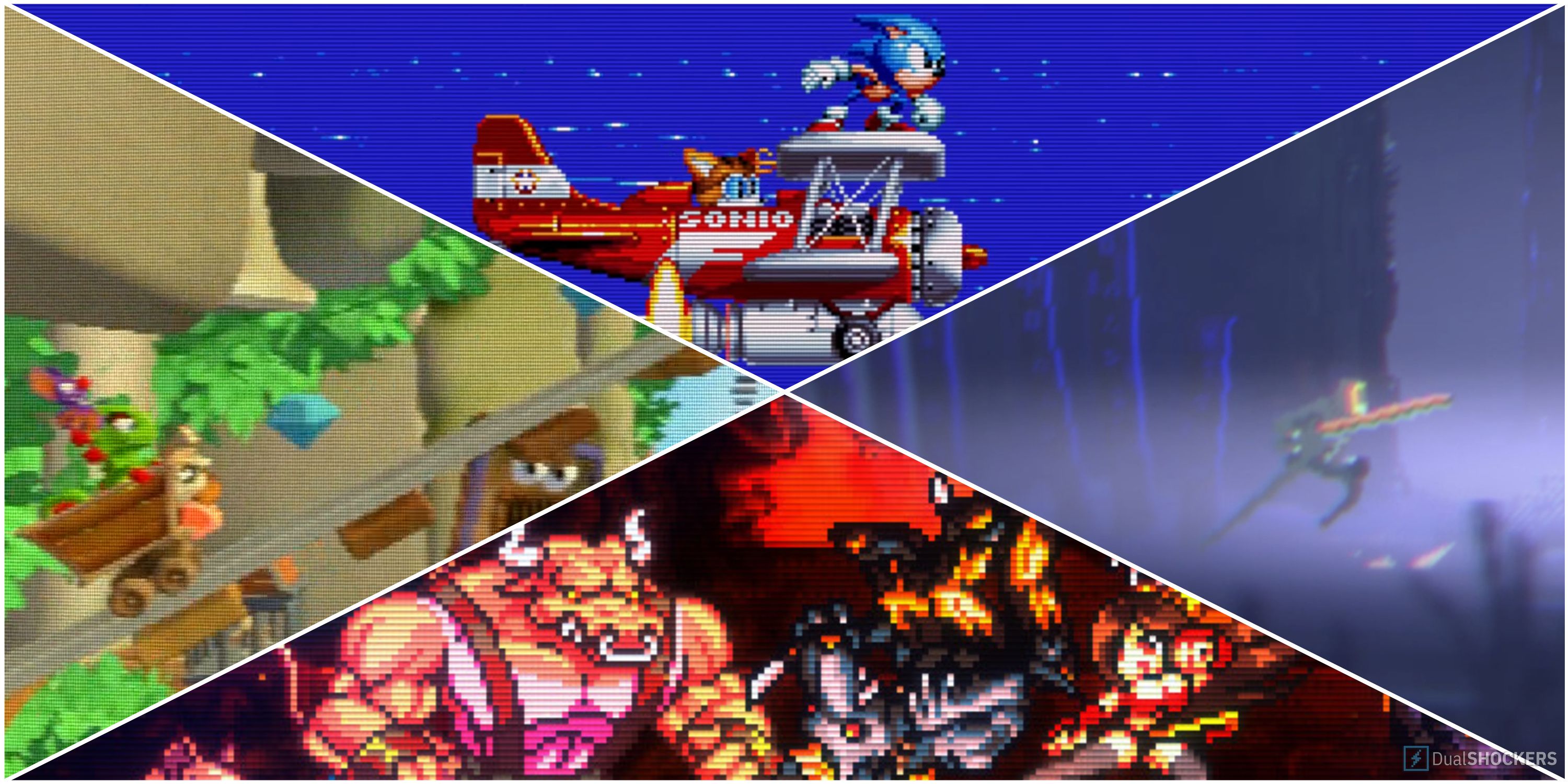
For those of you too young to remember, the primary form of home display before flat screens was cathode-ray tube televisions, or “CRTs” for short.
CRTs were the original format for home analog televisions, and those of us who grew up in the 80s and 90s did all of our gaming on them.
Related
10 Modern Games With Retro Throwback Sections
Games like Bayonetta and Wolfenstein 2 feature references to classic home and arcade video games, some more overt than others.
CRTs aren’t the standard format anymore, mostly relegated to novelty purposes.
However, there are quite a few games that seek to emulate the warm display of these devices using built-in filters.
Some of these filters are optional features that can be enabled in a game’s settings, while other games have them as part of their default display for thematic purposes.
10 Cyber Shadow
Right Out Of An NES

Cyber Shadow’s 8-bit graphics are deliberately reminiscent of other ninja-centric games of the NES era, such as Ninja Gaiden and Shadow of the Ninja.
As the game console that played a big role in reinvigorating the industry after the Crash of ‘83, the NES and its games deserve any bit of homage we can give them.
To complete the illusion of playing 8-bit games on your living room TV in the 80s, Cyber Shadow has an optional CRT filter in its settings.
In addition to the curved screen and scan lines, there’s also a “Bad Wires” effect you can turn on to cause a bit of screen ghosting for a really authentic experience.
9 Blasphemous
Low-Def Old Testament

While Blasphemous does have pixel art graphics, it doesn’t appear to be a reference to any particular retro game (besides Metroid and Castlevania, obviously).
Even so, you don’t need to make a particular reference to bask in the stylings of the retro era.
If you want your religious crusade to be a bit blockier, Blasphemous has an optional CRT filter in its settings.
This filter has four presets, with the first one just adding some scan lines, the second one adding screen curvature, and the third and fourth ones washing out the colors.
8 Yooka-Laylee
Back To The N64

From the very moment its Kickstarter began, Yooka-Laylee made its roots in the Nintendo 64-era Rare games very clear.
Most of the game’s elements were clear send-ups to the collect-a-thon 3D platformers of ages past.
Naturally, as we played games like Banjo-Kazooie on CRTs, Yooka-Laylee would need to offer a similar display experience in tribute.
One of the game’s unlockable Tonics, aptly named “64-bit,” renders the entire game in a style akin to an old N64 game.
This includes low-poly models, washed-out worlds, and of course, a CRT filter covered in scan lines.
7 Sonic Mania
Genesis Did What NintenDon’t

The original Sonic the Hedgehog game was released in 1991 for the Sega Genesis (or Mega Drive if you prefer).
The early 90s was still firmly in CRT territory, with the classic scrolling levels accompanied by lovably chunky pixels and scan lines.
As Sonic Mania is a love letter to the original era of the blue blur, it includes an optional CRT filter in its settings.
There are two CRT filter settings you can choose from: the Sharp filter, which has a much more stark contrast, and the Soft filter, which smooths out the edges a bit and highlights colors.
6 Fight’N Rage
Like A Cabinet In A Dim Arcade

CRTs weren’t only for home televisions; they were also integrated into arcade cabinets.
This was rather nice when you were playing a multiplayer beat ‘em up since the curvature of the screen helped everyone with a joystick to see.

Related
10 Best Beat’Em Ups, Ranked
The beat’em up genre is home to some great titles, spanning from the early arcade days until now. Check out the best they have to offer.
Fight’N Rage has this same arcade display style, with a CRT filter enabled by default.
This gives the whole game view a distinct curvature, plus some static-y scan lines to remind you of those dimly-lit arcades of the late 90s.
You could turn the filter off if you wanted to, but why would you want to?
5 Narita Boy
Embodiment Of The 80s

CRTs could be considered one of the signature elements of 80s-era pop culture, alongside neon lights and synth music.
As a game steeped in 80s stylings, Narita Boy features all three as part of its overall aesthetic.
The game has an ever-present CRT filter, making it look as though you’re always watching through an old, slightly washed-out display.
It’s a playing experience somewhat reminiscent of bringing home a VHS tape of Tron in 1987 and watching it on your tiny bedroom TV.
4 Hotline Miami
Scan Lines Warping Reality

The story and gameplay of Hotline Miami are presented to us through the viewpoint of a man during a serious breakdown and a severely loose grasp of reality.
It does this by sprinkling 80s-styled CRT flavor throughout the game.
The colors are severely washed out, almost to the point of being uncomfortable to look at, kind of like an arcade machine that’s had a magnet stuck to it.
This is accompanied by heavy scan lines which, when combined with the top-down view, kind of feels like watching the protagonist’s rampage through an old security camera.
3 Katana Zero
Fast-Forward, Rewind


- Released
- April 18, 2019
- Engine
- gamemaker
- ESRB
- M For Mature 17+ Due To Blood and Gore, Strong Language, Suggestive Themes, Use of Drugs and Alcohol, Violence
- How Long To Beat
- 5 Hours
- OpenCritic Rating
- Mighty
In a similar vein to Hotline Miami, Katana Zero uses retro tech stylings to reflect its protagonist’s mental state.
In Zero’s case, it comes with his mysterious drug-induced precognitive abilities.
At the start of every stage, we see him ponder for a moment, accompanied by CRT distortion, as he plans out his route of attack.
Once you clear a room, the entire sequence repeats as though it were being displayed on a security feed, complete with screen warping if you rewind or fast-forward.
2 Loop Hero
Memories Of Graphical Interfaces

Loop Hero
- Released
- March 4, 2021
- Developer(s)
- Four Quarters
- Engine
- GameMaker
- ESRB
- T For Teen due to Fantasy Violence, Language, Mild Suggestive Themes
- How Long To Beat
- 30 Hours
- X|S Optimized
- No
- File Size Xbox Series
- 515 MB (November 2023)
- OpenCritic Rating
- Mighty
In addition to televisions and arcade cabinets, CRTs were also used as the earliest home computer monitors.
Granted, there weren’t exactly a lot of visual elements to appreciate in the age of text interfaces, but PC games got plenty of love once color graphics took off.
Loop Hero is something of a send-up to those late-stage graphical PC games, with its elaborate interface border and splotchy pixel graphics.
To complete the vibe, the game has an ever-present CRT filter, adding both subtle scan lines to the view and a very slight curvature reminiscent of those classic monitors.
1 Murder House
Like A Cheap VHS Tape

The 80s were a great era for schlocky slasher horror movies, with cheap special effects working in tandem with cheap displays to weird you out.
Murder House is a tribute to both those films and PS1-era horror games like Resident Evil, which were also best enjoyed on a CRT.
This results in a game that is riddled with not just CRT scan lines, but the subtle static and distortion that comes with a worn-out VHS tape.
It’s all a little overpowering, but it’s kind of supposed to be; it’s a game with an oppressive atmosphere both inside and outside the setting.

Next
10 Best Retro Horror Games, Ranked
Which classic retro horror games keep you up at night?